Followers

Thursday, February 8, 2018

February. A lesson in Thread Painting


Hello Ladies!

First off,  there were some nice comments related to me about the blog so I want to thank you for your kind thoughts.

This meeting we covered thread painting.  Sue Gilgen headed up this meeting's adventure and everyone I talked to said it was fun, they learned a lot and feel they can now start thread painting with more confidence.  We call that in the learning community "The Magnificent Trifecta".

Sue Gilgen, Carroll Lee Stolz and Margaret Abramshe set up three thread painting demo tables. Each member spent 20-25 minutes at each table. Sue Gilgen showed some of her tips and tricks.  Carrol Lee made a tumbleweed on solvy sandwiched between two pieces of twill.  Margaret  demonstrated casual thread painting on a drawing made on muslin. She demo'ed on a Brother machine to illustrate that you don't need an expensive sewing machine to achieve nice results.  Margaret also talked about thread painting on her Sweet Sixteen so if you have a midarm and missed the meeting - she is a resource.

No pics.  Sorry.  But here is the Info Margaret provided us prior to the meeting that you will find useful as you give thread painting a go:
A thread sketch uses your sewing machines capacity to turn a  line of stitching into a sketch by tracing an image you draw on  cloth.  
Supplies: Sewing machine, set to a basic straight stitch Thread -  my suggestion is a neutral or earth tone like black, dull green, gray,  or brown.  Bobbin thread does not have to match but should be something that does not “show” A scrap of muslin or any white or cream fabric about the size of typing paper or less Pilot  FRIXION erasable pen ( you could also use a quilters marking pencil or pen) Poly batting with fusible on one side.  (temtex works well too) 
 Instructions:
1. Draw a simple sketch of a house or landscape using the erasable pen or print a image that uses simple lines and trace that image. (Hint: look for images that are pencil drawings or sketches). The drawing should be less than 8 x 10 and not very complex.
2. Fuse a good fabric (I use kona cotton) to batting. Place the sketch on the non fusible top of batting.
3. Put this quilt sandwich under you standard foot along a line of the drawing and trace that line a few times. Leave the needle down and continue to trace the lines by moving the quilt sandwich. 
4. Try reversing the stitch direction to darken lines. 
5. DO NOT WORRY ABOUT GOING OUTSIDE OF THE LINE!
6. Without cutting the thread, put your feed dogs down. Push and pull the quilt sandwich along lines that are not straight or areas of your sketch that are shaded. Think of this like scribbling with your sewing machine instead of a crayon. 
7. Play, play and more play with feed dogs up or down.  
When you are done, get out some watercolors or water soluble pencils and color in your picture possibly adding a background. As you color the erasable pen will disappear. 

Now get thread painting because that is your assignment over this month.  Bring your results to the next meeting which will be on March 6th where we will be learning all things beading.  Charm Crumrine and Jan Passek will be teaching.  Charm and Jan, do we need to bring anything for your purposes?

Wednesday, January 24, 2018

Fibers and Fabric

Rosemary talking fiber and fabric
 Tuesday Jan 9th Rosemary Hargrove gave a talk about fibers and fabric.  Rosemary ran a fashion fabric store for 22 years, and is very familiar with all types of natural and man-made fibers.  We discussed natural vs manufactured fibers and a variety of weaves.  We were able to touch and feel similar weaves made of different fibers and compare.  She put a name to many fabrics she passed around.  I think all left with a better understanding of the media that we all use and why.  All were challenged to experiment and use something different in a small work.  Cathie Purdy was also there to show her collection of silk fat quarters available to add to your collection.

Cathie Purdy was also there to show her collection of silk fat quarters available to add to your collection.
A closer look for the web browsers...
Thank you to Rosemary and Cathie for providing us with such an informative talk and Cathie for binging in her silk collection.  Also thank you to Carroll Lee for holding down the meeting and blog fort while Cheryl and I were gone.

Show and Tell

Hi Ladies,

You'd think being confined to reclining (yes, that's a thing, not just something I made up - but I totally wish I had and could call it medicinal) that I would have jammed out a post on all the lovely show and tell items our artists brought in.  But no.

I was actually building the anticipation. 

OK up to bat #1:  Patti Van Oordt's appliques were a part of 12 fusible applique quilt blocks in the book Seasonal Silhouettes by Edyta Sitar.  Each block represents a different month and can be assembled into a large quilt or used as smaller wall hangings.


So the first is memorializing summer.  Haha, just kiddin ya.  Very festive.

 I am picture level challenged.  Sorry Patti.
 Patti brought in the Christmas tree you see in the background.  She is all about creating mood for her art.  Clever.


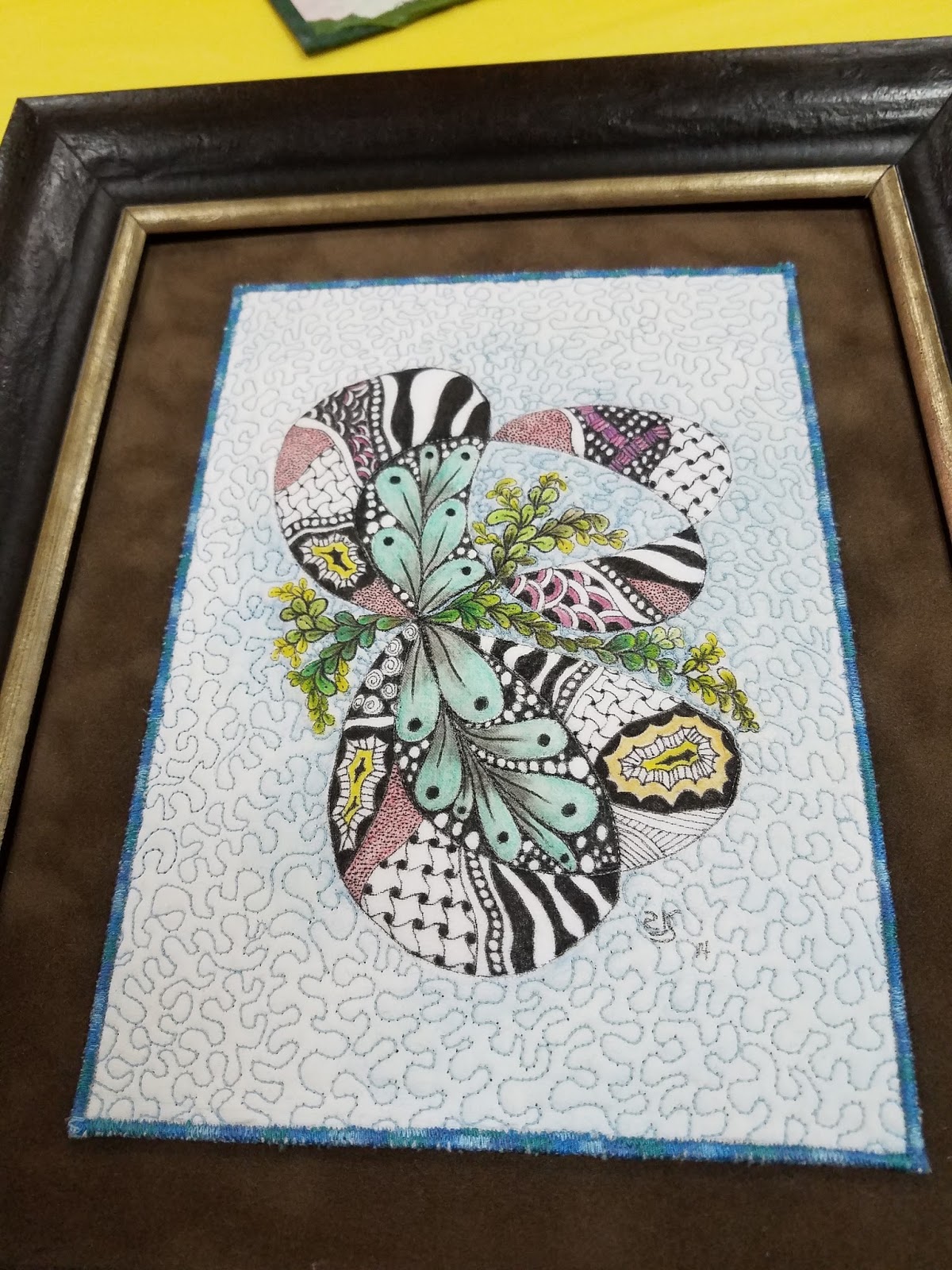
 And here we have Sue Swinyard's zentangle.  Her zentangles are so interesting and different.  Love.


January brought in some new and interesting treasures.  Wish I was there to see them live.  Thank you ladies of January's art installments (and Patti for December's) for such good descriptions.  Big thank you to Carroll Lee who took all the picture and for making me laugh with her emails.  Needed that lady.

First January entry:  Charlotte Gary's  "Still Beautiful". She says:  "When people do flowers, they tend to only draw the buds or flowers in various stages of bloom. I have been focused on the flower that is in it's later stages of life, much like most of us are. We are 'still beautiful'. I just wanted to show that. (she did)  I textured the canvas with a texture medium and painted it with acrylic paint. I wrote and scratched out words. Things like life and death, the circle of life, beginning and ending. My grandma's names, my mom's name, my aunt's names my mother-in-laws names and my girls names.... I placed the roses, leaves and stamps over the word. I made the petals, leaves and other parts of the roses from silk, burning the edges, holding them over a candle. I glued the petals to the canvas with permanent white glue, added yarn for the stems... didn't like the way the yarn looked to I mixed the texture medium with paint and put that over the yarn.  I stitched some down and am stitching beads in place for the center of my focus flower. I still have more beading to do...."

I told her I liked "later in life" poppies. Anyone else like them?  Still pretty even when their showy flowers drop.  And functional.

And here is Cindy Oxley with her small quilt.It is one of three pieces she will be doing as a result of a really fun Laura Wasilowski class she took via the Dixie Quilt Guild.  It is a combination of quilting, fusing, fabric weaving and embroidery.

 Finally, Wanda Bublick brought a sampler made in a weaving class done over an 8 week period. Each week they were taught 2-3 new stitches. They added each one for about 1-2 inches then started a new stitch ending up with a Sampler about 3 1/2 feet long. The top a stick is one her dog brought back from a camping trip (the dog has good taste). Wanda said it was fun to learn a new skill and it has given her ideas for new art projects.

 OK now.  Check out the next post.  Short but sweet.   Hint: Rosemary sorta sweet.   See you in a few weeks! 

Monday, December 25, 2017

Merry Christmas!


They are dreaming of all the fiber they will be chewing and mauling next year.  It will be.... fabulous.

Monday, December 18, 2017

You Know It's a Party When...

The ladies don their party hats?
The ladies think paper plates are party hats?
Some tried to pretend they didn't enjoy the plates on their head.  Others enjoyed getting a room full of women to put paper plates on their head while they remained hatless (you know who you are).

But this table was filled with sporting women who wore their hats with elan!

What was the best part of the evening?  Feel free to leave your thoughts in the comment section.  I will leave mine here since I am writing the post.  I enjoyed meeting Cheryl's mom Louise.  She has a smile that is ever so charming.  It was also nice to see some of our members personalities.  Often we are sitting and listening or talking about projects we are working on, but last night it was more friendly and funny.  A real treat to be surrounded by both funny and talented ladies.

The best news of the evening is that Cheryl said she wants to lead the group for another year!  Apparently she enjoys hard work and stress.

I wish I had a picture of Cheryl with a mean face because I would insert it right here.  
 But I don't have one. 

 Mean face because she is reading that part about leading another year and wants to throttle me.  Nope.  She is giving us 6 months to find another fearless leader.  Luckily there are plenty of talented and well organized ladies to step up and lead.  Consider it and let Cheryl know.

Now for your entertainment... a little video of the post card challenge:


Now how about some Show and Tell!  No I am holding those back for next month.  Sorry.  They were really good too.   😁

But.  There is one last thing...

Next meeting:  Bring in any fabrics you have that you have ever wondered what they are and how to handle them.  We will be getting a nice lesson on all things fabric.

Until then, happy new year, merry Christmas, happy Hanukkah and may the new year be full fabric lint and thread from manic. blissful creation!


Tuesday, December 12, 2017

Inchie, Twinchie, Rinchie, Rolo, ATC, Moo... Oh My!


If you missed December's meeting we were tossing around doing an inchie challenge for January.  Many of us didn't know what they were.  Didn't know our Twinchie from Rinchie!  So Carroll Lee Stolz offered to clear things up.


INCHIE, TWINCHIE, RINCHIE, ROLO, ATC, OR MOO?
Are you familiar with any of these? How about ACEO or Artist Postcards? They are new obsessions for quilters around the world. You may have heard of an Artist Postcard. Maybe you’ve made some, or received some from someone who thinks you are very special. 
 
Have you been surfing Pinterest, EBay or Etsy and wondered what the heck are “Inchies” anyway? Or, you may know what an Inchie is and wonder, “WHY”??? These are small artworks, and they’re not just for painters, paper crafters or woodworkers. Many are being made by those of us who love fabric and thread, too. That means us!

Let me demystify:

INCHIE: It’s a 1” x 1” piece of artwork. First popular with paper crafters, it is becoming popular with fiber artists and quilters as well. As long as it’s an inch squared, you can use any media you like to make it, paper, fabric, wood, metal… the list goes on! A favorite seems to be the collaged Inchie, with a combination of words and images making up the artwork. For quilted Inchies, imagine attaching them together with thread or yarn to display as a piece of fiber art. Trading and collecting these is a fun hobby and doesn’t take much time or materials. It lends favor to using those itty-bitty pieces of “something good for something” we have in a box or baggie somewhere in our sewing rooms—you know; tiny beautiful fabric scraps, ribbon, yarn, lace, selvages, etc. (If you have these, you know who you are!)


TWINCHIE: These are 2" x 2" squares. Like an Inchie, but twice as big! Twinchies are perfect if Inchies are a wee bit too small for you! Other than the larger size, they are exactly like “Inchies”.


RINCHIE: These are 1” circular artwork. The great thing about Rinchies is that they fit into the underside of a bottle cap, so you can turn them into any number of decorative things! If you have a bottle cap, making a template is easy. Once affixed inside the bottle cap, it becomes a tiny framed artwork. Rinchies are cute, collectible, tradeable, sweet little pieces of textural delight.


ROLO: This is artwork produced by altering a Rolodex® card. Typically, the Rolodex card size is 3” x 5”. The cards may be made for the rectangle box-style, or the round Rolodex. For those who have used, or remember what a Rolodex IS, know the cards are sold in office supply stores. One style had two little cut-out notches at the bottom to accommodate a pair of grabbing bars in the base of a special roll-able desktop box. Another style is rectangle, without the cut-outs, and are designed for the rectangle card box. The rectangle cards (without the cut-outs) are transformed into art, what is called a “ROLO”. What a fun, artistic way to keep up your mental artistic dexterity.


ATC: Artist Trading Cards are strictly sized at 2-1/2” x 3-1/2”. That is the size of playing cards (Canasta, anyone?), and baseball trading cards. This precise size is necessary in order to trade them (and that’s really the whole point) so they will fit into the sleeve of a baseball card protector. These protectors always have the same size pocket, but do come in various styles; pages for a 3-ring binder, or individual sleeves, and other choices for display.
ATC’s are self-made works or small series, signed and dated on the reverse by the artist, exchanged and collected by the people who participate in a collaborative performance. Some collections, and individual cards have been shown in art galleries around the world. But, don’t let that scare you. Anybody can make, collect and trade ATC’s.
There are many groups that trade ATC’s. For instance, there are on-line trading groups, magazines, art groups, as well as art and quilt guilds. Friendship groups are a great place for a quilter to start trading. Usually a group’s coordinator will set the parameters of a specific trade challenge. Other than the strict requisite 2.5”x 3.5” size, and requiring a bit of information on the back, anything goes.
As an example, Quilting Arts Magazine (June/July 2017 issue) called for ATC’s, with a subject called “Cup-O-Comfort”. The challenge rules were decided by the magazine editors, and they allowed plenty of time for design, creation and entry. Look for a gallery of results in the December, 2017 issue. (Post Script: Since I originally wrote this article, my first ever ATC was published in the December issue of Quilting Arts Magazine, page 58).

ARTIST POSTCARDS: Did you know you can actually mail an artist postcard? Did you know you can mail a coconut through the USPS if the address and postage is applied to it. It’s true. I have mailed many coconuts from Hawaii to the U.S. mainland!
The Artist Postcards are hand-made works which are mail-able, but with special handling. USPS price to mail a 4” x 6” postcard is currently 34₵. However, Artist Postcards require special handling and will cost more than the average postcard. When mailing them, it is necessary to take them to the clerk at the Post Office desk rather than dropping into a mail slot. Don’t you agree it would be fabulous to send an Artist Postcard to someone special? 
*(Postcards with 3-dimensional elements and embellishments need to be sealed in a clear envelope. For purchasing information, see note below.)


MOO: To be specific, “Moo” is the name of an online company (Moo.com) which produces luxury business cards. Their product is a 1-1/8" x 2-3/4" rectangle. Designed and printed to contain a photo of artwork or other objects on one side and written info on the other, these are now made and traded in the same way as ATC's and Inchies. Many professional artists cut up Moos and collage them into a works of art. Although these cards are no longer necessarily printed JUST by Moo, any brand of these types of cards can be cut and collaged yourself! Moo is a company AND a trading card.
Not much about the Moo really applies to the quilter or fiber artist, except that you might want a superior business card and collect and trade them, too. After all, if you wish to sell your work, you might need fabulous business cards. I asked the question, “Why did a business card company choose the name ‘Moo’”?? The company says, it’s a strong, hearty word, easy to say, easy to remember and it makes a great URL. I agree. 

ACEO: These, also, would appeal most to the professional amongst us. You may run into this acronym in the art world. It is, “Art Cards, Editions And Originals”. This style of making small art is usually reserved for the professional in the art business, and for artists who need their own, unique “business cards” to promote the sale of their work. They are sometimes used as small “gifts” to potential patrons, or as their business card. But you don’t need to be a professional artist to collect these. ACEO cards are sold, collected and traded like baseball and hockey cards. I only mention them here because they might appeal to fiber and quilt artists who sell their work.

Making small art gives you the advantage of making something quick, using scraps and left over items, plus allowing you to practice and explore surface design, painting, inking, stamping, embroidery, hand and machine stitching, collage and designing skills. These small pieces take up very little space on your wall or in a collector’s box or catalog. Creating smalls offer the opportunity to test the waters outside your comfort level. It’s always enriching to try something new and different. They are thrilling to receive from another artist, and are wonderful conversation starters in any gathering of quilters or quilt artists.

Wouldn’t it be fun to be a part of a “small art trading” group? It could be a great activity for quilt guilds, friendship groups, or individuals who want to join an on-line trading group. Look for the calls in art magazines or on-line groups. Think of what a wonderful exhibit an assemblage of these would make in the DQG quilt show next year! Jump in… the fun is waiting!

*Crystal Clear, Self-Sealing Bags, 4-1/8” x 6-1/8” are made by ©Darice, Inc., www.darice.com (Wholesale). Retail purchase can be made at www.amazon.com and www.consumercrafts.com A 50-piece unit costs approximately $2.50 (+ p/h).
When mailing your Artist Postcard in the Crystal Clear bag, the bag should not be sealed until the postmaster has applied postage to the postcard.

Sunday, December 3, 2017

AAUW Call for Women Artists Exhibit Entries


 Hi ladies,

Cheryl wants you all to know that the AAUW Utah Women Artists Exhibit is scheduled for May and June of 2018 in West Valley City Utah and that they are calling for entries.  Below are the links to all the information you will need.  Entry deadline is Feb. 16, 2018

Some quick facts: 
  • You can enter up to 3 pieces at $15/ piece
  • All work must be original and created within the last 2 years
  • Previous exhibits have yielded over $9k to 15 talented artists
  • Categories: Student, Amateur, Mature Amateur (over 50), and Professional 
Links:
AAUW Utah Women Artists Exhibit Website
Artcall Entry Information

If you are curious about previous years' entries, here is their Facebook page with lots of pictures from previous exhibitions.  AAUW Facebook Page

Good luck ladies and I hope to see some of you enter.  If some do enter maybe we can carpool up to the exhibit to support our entrants!